
Scenes for two actors: ten short duologues, staged
Ten short scenes for two, ready to read aloud or to stage with your own characters.
A duologue is a scene with two speaking parts. Collins puts it plainly: “a part or all of a play in which the speaking roles are limited to two actors.” Two people, two wants, nowhere to hide.
Here are ten short duologues, written for this post: five comic, five dramatic. Each one has a title, a one-line setup and a handful of lines. They are clean, so they work as duologues for teens, and no part depends on gender, so they suit two female actors, two male actors or any pair.
How to use them
Read a scene once for the story. Then decide what each character wants, and what they will do to get it.
Drama teachers work this way with contentless scenes, also called open scenes: scenes with very little detail about character or plot, where pairs invent the characters, their relationship, the setting and the conflict, then test those choices in rehearsal. Several of these scenes leave room on purpose. Change the setup and the same lines play another way.
Swap the names for your own. Then read them out loud, rehearse them with a partner, or stage them with your own characters.
Five comedic scenes for two actors
The last slice
Two roommates meet at the fridge at midnight. One slice of pizza is left.
SAM: You’re awake.
JO: So are you.
SAM: I came down for water.
JO: The water’s in the sink. You’re holding the fridge door.
SAM: The fridge has colder water.
JO: The fridge has the last slice.
SAM: Does it? I hadn’t noticed.
JO: It has a sticky note on it. In your handwriting. It says “MINE.”
Pet-sitting
One friend is home early from a trip. The other was looking after the cat.
OWNER: I’m home. Where’s Biscuit?
SITTER: Biscuit is fine. Biscuit is thriving.
OWNER: That’s not a where.
SITTER: He’s on the roof. Emotionally, he’s in a great place.
OWNER: How did my cat get on the roof?
SITTER: I was hoping you’d tell me. You’ve known him longer.
The understudy
Opening night. The lead has lost their voice, and the understudy did not plan for this.
LEAD: (whispering) You’re on.
UNDERSTUDY: On what?
LEAD: Stage. Now.
UNDERSTUDY: I learned your lines as a joke.
LEAD: Then be funny.
UNDERSTUDY: It’s a tragedy.
LEAD: Not anymore.
The volcano
Two classmates present a science fair volcano. Only one of them built it.
PRESENTER: And that’s how a volcano works. Any questions?
PARTNER: I have one. Who built the volcano?
PRESENTER: We did. As a team.
PARTNER: I had the flu all week.
PRESENTER: Teamwork is a state of mind.
PARTNER: Then my mind would like half the grade.
Nothing ever happens
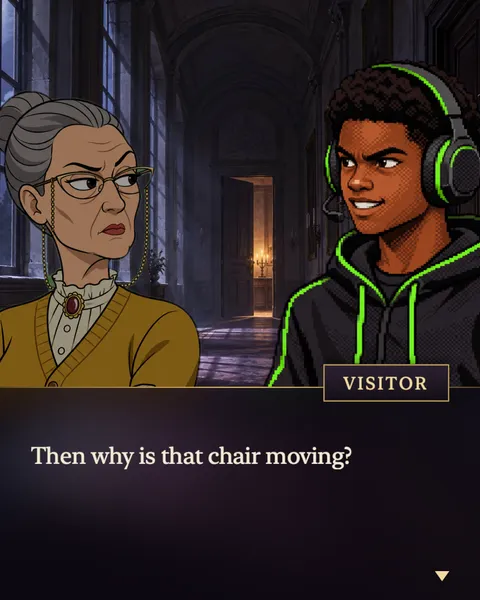
A tour guide and the last visitor of the day, in a house said to be haunted.
GUIDE: And this is the room where nothing ever happens.
VISITOR: Then why is that chair moving?
GUIDE: Drafts. It’s an old house.
VISITOR: It’s moving toward us.
GUIDE: A very old house. Very curious drafts.
VISITOR: You said nothing ever happens.
GUIDE: I said that on the tour. The tour ended a minute ago. Run.
Five dramatic scenes
The cast list
Two best friends read the cast list for the school play. Only one of their names is on it.
RILEY: Say something.
KIT: Congratulations.
RILEY: Say something true.
KIT: I practiced my face for when I got the part. I don’t have a face for this.
RILEY: I’ll turn it down.
KIT: Do that and I’ll never speak to you again. Go learn your lines.
The night before
A squire asks to be sent home before tomorrow’s battle.
SQUIRE: I can’t carry the banner tomorrow.
KNIGHT: Your hands are steady.
SQUIRE: My hands are. The rest of me is halfway home.
KNIGHT: Then let the rest of you go. Your hands stay with me.
SQUIRE: Is that an order?
KNIGHT: It’s a favor. I’m scared too.
The platform
Two old friends meet again on the platform where they argued a year ago.
ALEX: You kept the scarf.
JAMIE: You kept the ticket.
ALEX: I meant to use it.
JAMIE: You had a year to use it.
ALEX: I had a year to be brave. I spent it on other things.
JAMIE: And now?
ALEX: Now I’m here. Late, but here.
The last beaker
Lab partners clean up after the last class of the year.
DREW: That’s the last beaker.
QUINN: Then we’re done. For good.
DREW: You say that like it’s bad news.
QUINN: It was the best class I ever took. And it wasn’t the chemistry.
DREW: …What was it?
QUINN: You know what it was. You always know the answer before I do.
That one is a confession in six lines. To write your own, see how to write a confession scene.
The garden
A new ruler asks the oldest advisor at court about the old king.
RULER: Was my father a good king?
ADVISOR: He was a careful one.
RULER: That isn’t what I asked.
ADVISOR: It’s the answer I can give in this room.
RULER: Then walk with me in the garden.
ADVISOR: In the garden, Your Majesty, I’ll tell you everything.
Stage a duologue in DialogCut
Velvet is DialogCut’s stage drama theme. Your two characters face each other over a velvet band, the speaker lit and the listener in shadow. Narration dims them both, which suits a stage direction, and title cards arrive in gold.
The same stage plays comedy and drama: The last slice is on the Rose look, The garden on Onyx. Change the look and the mood follows.
- Build your cast. On Stories, tap New story and pick two characters, or tap New to bring your own: a drawing, a sketch, a meme. DialogCut removes the background, and your characters face each other on stage.
- Name the scene. Tap Add, then Title Card. Put the scene’s name in Title and the setup in Subtitle.
- Set the place. Tap Add, then Background, and pick a painted place from Sample Backgrounds or your own picture or video from Open Gallery.
- Write the lines. Tap a character to add their line. Write a stage direction, like (whispering), as narration.
- Find your look. On Preview, tap Themes and pick Velvet. Rose suits a comedy, Onyx a drama.
- Export a video. Tap Format and pick 16:9 for YouTube or 9:16 (Social) for TikTok, Reels and Shorts. Tap Export, then Start, then Save video.
Every line is timed for reading, so the video makes a patient scene partner: play it back and read along. See every step on how it works.
Your scene, your cast
Pick a duologue, cast it with your own characters and give it a stage. Get DialogCut on the App Store or Google Play.
Sources
- “Duologue,” Collins English Dictionary, on Dictionary.com: https://www.dictionary.com/browse/duologue
- “Contentless Scenes (‘Open’/‘Ambiguous’ Scripts),” Tes: https://www.tes.com/teaching-resource/contentless-scenes-open-ambiguous-scripts-drama-theatre-resources-gcse-a-level-ks3-11435272
- Lindsay Johnson, “Contentless Scene Brainstorm,” Drama Teacher Academy, Theatrefolk: https://www.theatrefolk.com/dta_lesson_plans/unit-four-intro-to-scripted-scenes-contentless-scene-brainstorm