
How to write a confession scene
Build the moment line by line: the setup, the pause, the words, and the answer that changes everything.

A confession scene is short. One character says what they have been holding back, and the other has to answer. Everything before it was setup. Everything after it has changed.
It is also the scene your readers wait for, so the words carry the whole story so far. Here is how to write a confession scene line by line, with ideas to start from and a way to stage it with your own characters.
What makes a confession land
A confession is a risk. The scene works when the reader feels what saying it could cost.
The words themselves can be plain. In Japan, a formal love confession has its own name, kokuhaku, and Tofugu describes it as the moment a relationship officially begins. The basic version is two short sentences, “Suki desu. Tsukiatte kudasai,” which Tofugu translates as “I love you. Can we start seeing each other?”
Nothing fancy. The weight comes from everything around the words. So don’t polish the line until it shines. Make it hard to say.
Build it in four moves
The setup: a reason not to say it
Give your character something to lose. They are best friends, and this could end that. They are rivals, and saying it feels like losing. One of them leaves in the morning.
Then put them somewhere ordinary: a train platform, a kitchen, a classroom after the last bell. The quieter the place, the louder the line.
The pause: let the silence work
Before the words comes a breath. Jane Austen writes one into Pride and Prejudice, right before Mr. Darcy’s first proposal: “After a silence of several minutes, he came towards her in an agitated manner.” You know something is coming before he says a word.
In your script, a pause can be narration (“Neither of them looks at the clock.”), a line about something else (“The train’s late.”), or an ellipsis that makes the words wait.
The words: short, specific, theirs
Skip the speech. Darcy opens well: “In vain have I struggled. It will not do. My feelings will not be repressed. You must allow me to tell you how ardently I admire and love you.” Then he keeps talking, about her family and his pride, and he loses her.
Give your character one or two sentences in their own voice. A shy character hedges. Shakespeare’s Benedick tests the idea out loud: “I do love nothing in the world so well as you. Is not that strange?” A blunt character says it flat. A funny one makes a joke, and the joke breaks halfway through.
A detail says more than a declaration. “You always save me the window seat” lands harder than “I’ve always liked you.”
The answer: the second half of the scene
The answer is where the story turns: yes, no, not yet, or something nobody saw coming.
Much Ado About Nothing shows how far it can turn. Beatrice answers Benedick: “I love you with so much of my heart that none is left to protest.” He tells her to ask anything of him. Her reply is two words: “Kill Claudio.” Claudio is his friend, who has shamed her cousin at the altar that same day. The confession is done, and the play changes direction.
Elizabeth Bennet’s answer turns a story too. She refuses Darcy, and the rest of the novel grows out of that no.
Whatever the answer is, write it. A confession with no reply is half a scene.
A short example
Here is a whole confession scene, small enough to stage tonight.
Title card: Last train · The platform, after midnight
Narration: The last train is late. Neither of them minds.
SORA: You can go. I’ll be fine.
ASH: I know you’ll be fine.
Narration: The board flickers. Nobody looks at it.
ASH: I take this train every night because you do.
SORA: …Every night?
ASH: I like you. That’s the whole speech.
SORA: I don’t live on this line. I’ve been taking the long way home since spring.
The setup is the late train. The pause is the board nobody watches. The words are short and specific. The answer turns it around: Sora has been doing the same thing all along.
Love confession scene ideas
Start from one of these and change it until it is yours.
- The rehearsal. A character practices a confession on their best friend. The best friend is the one they mean.
- The wrong person. The confession reaches someone it was never meant for, and they have to answer anyway.
- Mid-argument. Two rivals are trading insults when it slips out.
- The goodbye. One of them moves away tomorrow. There is one evening left.
- One umbrella. It starts to rain, there is one umbrella, and the walk home takes longer than it needs to.
- The letter. Someone reads an unsigned love letter out loud. The writer is in the room.
- The late answer. The confession happened chapters ago. This scene is the reply.
- Not about love. Some confessions are secrets: a lie, a fear, news for a parent. “Dad. Before dessert, I need to tell you something.” follows the same four moves.
For more two-person scenes to adapt, try ten short duologues, staged.
Make it in DialogCut
Flirt is DialogCut’s romance and otome theme, made for this scene: one face close up, an ornamented card, and the name on a ribbon with a heart. When the other character answers, their face takes the frame and the card stays. Narration darkens the card while the face steps back.
- Build your cast. On Stories, tap New story and pick your two characters. To bring your own, tap New, give them a name and a Signature Color, and pick their portrait under Choose Portrait. DialogCut removes the background.
- Write your story. On Script, tap a character to add a line. Tap Add for narration, a title card or a background change.
- Hold the pause. On Preview, tap a background change and set its Hold. The stage clears and the new place shows on its own, a night sky before the words.
- Find your look. Tap Themes and pick Flirt, then a look such as Sakura or Gilt. Under Text reveal, Typewriter lands the words one letter at a time. Pacing sets how fast lines appear and how long they stay.
- Export a video. Tap Format and pick 9:16 (Social) for TikTok, Reels and Shorts. Tap Export, then Start, then Save video.
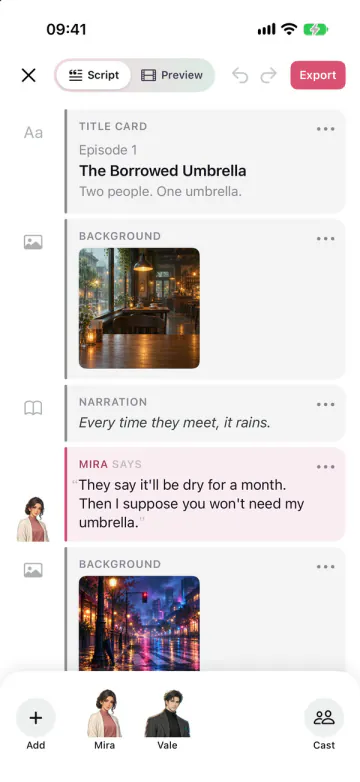
Your script reads top to bottom, the way the scene plays. See every step on how it works.
Give them the words
Write the line your characters have been holding back, and watch the answer land. Get DialogCut on the App Store or Google Play.
Sources
- Mami Suzuki, “Kokuhaku: Japan’s Love Confessing Culture,” Tofugu, 2013: https://www.tofugu.com/japan/kokuhaku-love-confessing-japan/
- Jane Austen, Pride and Prejudice, chapter 34, Project Gutenberg: https://www.gutenberg.org/ebooks/1342
- William Shakespeare, Much Ado About Nothing, act 4, scene 1, Folger Shakespeare Library: https://www.folger.edu/explore/shakespeares-works/much-ado-about-nothing/read/4/1/