
A short history of the dialogue box
From speech scrolls to Persona's ransom notes: how the dialogue box learned to name the speaker, set the pace and act.
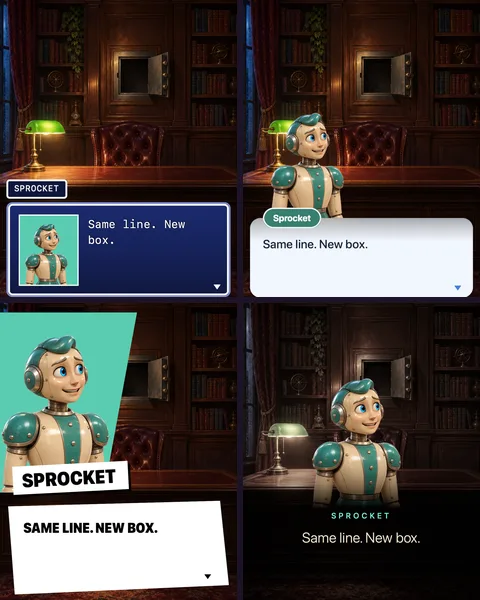
Every dialogue box solves the same problem: putting words in a mouth that cannot move. A drawing cannot speak, a sprite has no lips, a portrait on a phone screen holds still. So somebody draws a shape, puts the words inside it, and points it at whoever is talking. Here is how that shape grew from a curl of ink into the most familiar rectangle in games.
1. Scrolls, banderoles and balloons
Long before comics, artists attached speech to bodies. Mesoamerican art from about 600 to 900 CE used the speech scroll, a wispy line drawn from a speaker’s mouth. Western art labeled what figures said from at least the 13th century, and 18th-century broadsides carried banderoles, word balloons that turn up in American Revolution cartoons, some published by Benjamin Franklin, and in James Gillray’s caricatures.
Then the balloons faded. Rodolphe Töpffer’s picture stories, reprinted throughout Europe, set the text under the images, and artists came to prefer dialogue running under the panels. In 1896 Richard F. Outcault’s Yellow Kid wore his words on his shirt, and balloons much like today’s joined him almost at once.
Comics left the dialogue box two inventions it still uses. The tail says who is talking. The caption, a box near the panel’s edge, is the narrator’s voice, belonging to nobody in the picture. Comics also sorted balloons by manner (speech, whisper, thought, scream), so the container itself could tell you how a line was said.
2. The window at the bottom of the screen
Early computer games were mostly text. When pictures arrived, the words needed a place beside them. Yuji Horii’s The Portopia Serial Murder Case (Enix, 1983) told its murder mystery in pictures and text. It inspired designers such as Hideo Kojima, and Retro Gamer credits it with defining the visual novel genre.
Horii’s Dragon Quest (Chunsoft and Enix, 1986), with Akira Toriyama’s art, moved its story forward through dialogue: much of the game is spent talking to townspeople. Their words sat in a bordered window low on the screen, a few lines of large type, always in the same place. That plain window became a style that outlived the televisions it was made for.
3. Speed becomes a setting
Once the window existed, someone had to decide how fast the words appeared, and some games handed that choice to the player. Pokémon Red and Green (1996) offered three text speeds: Slow waited five frames per character, Medium three and Fast one. At about sixty frames a second, that is roughly 12, 20 or 60 characters a second. Reading speed had become part of the design.
EarthBound went further and let you choose the window itself. Its window flavors (Plain, Mint, Strawberry, Banana and Peanut) recolored every text box in the game. The same words, the same box, a different mood: the first looks for a dialogue box.
4. The box learns to act
In the 1990s Japanese adventure games turned toward reading. Chunsoft sold Otogirisō (1992) as a “Sound Novel”, and Leaf’s Shizuku (1996) was the first commercial game described as a visual novel. The genre settled into two layouts it still uses: ADV, with a text box over part of the screen, and NVL, with text over nearly all of it.
The box also started sharing the stage with people. Character portraits stood in front of painted backgrounds, the speaker’s name sat above the text, and the art changed with the mood. One history of the genre describes the shift as a move from manga-like composition to “theatrical presentation”. The dialogue box was no longer a caption under a picture. It was the bottom of a stage.
That stage went worldwide with Ren’Py, a free engine first released in 2004. By 2023, over 7,800 visual novels had been made with it.
5. The box gets a personality
Phoenix Wright: Ace Attorney (2001), written and directed by Shu Takumi, turned a text box into a courtroom. You press a witness on each statement or present the evidence that breaks it, and midway through development the team added the cries “Objection!” and “Hold it!”. A one-word shout, a slam, a burst of text: the box had learned to interrupt.
Toby Fox’s Undertale (2015) named two skeletons after typefaces and set their lines in them: Sans in Comic Sans, Papyrus in Papyrus. Typography had become character. You knew who was talking before you read a word.
6. The box gets loud, then breaks
Persona 5 (2016) treated text as graphic design at full volume. Its lead UI designer, Masayoshi Suto, took the lettering from the ransom-note covers of Sex Pistols albums, and director Katsura Hashino has said the angular screens were impossible to read at first, until lots of tweaking made them legible. The lesson cuts both ways: a box can shout, as long as it still reads.
A year later Doki Doki Literature Club! (2017), made in Ren’Py, used the genre’s comfort against its players, and the trusted text box itself became the thing that went wrong. Once a form can be subverted that well, it has become a language.
7. The box leaves the game
People started wanting the box without the game. objection.lol, launched in 2019, let anyone build Ace Attorney exchanges, and its memes spread across Twitter and YouTube. The box had become something people make, not only something they read.
8. What a good dialogue box does
Forty years of boxes boil down to five jobs.
- It says who. A tail, a name tab, a plate, a color.
- It sets the pace. Fast enough to keep moving, slow enough to read, with room to breathe at the end of a sentence.
- It leaves the picture room. Low on the screen, a few lines at most, so the faces and the place can act too.
- It has a narrator mode. The caption’s descendant: a voice that belongs to nobody, styled so you never mistake it for a character.
- It has a personality. Material, type and motion that tell you the genre before the first word lands.
DialogCut is built on those five jobs. Each of its eight themes is an answer: Novel’s frosted box with a name pill, Quest’s bordered window with a face tile and a name tab, Impact’s comic panel with a stamped name, Mist’s film caption with no box at all, Velvet’s band between two figures, Glitter’s pair on tinted glass, Deadline’s poster strip with the name set big, and Flirt’s ornamented card with a ribbon. Same script, eight boxes, each one older than it looks.
Make your own dialogue box video
- On the Stories tab, tap New story. In Choose Characters, tap New, name your character and pick your drawing with Photo Library. DialogCut removes the background. Tap Choose.
- Tap a character in the bar to write their line, and Add › Narration for the narrator.
- In Preview, tap Themes and try the boxes: Quest for the window, Impact for the panel, Mist for no box at all.
- Pick a Text reveal, then set the Pacing until every line reads right.
- Tap Export, then Start.
Questions
What is a dialogue box called? Text box, textbox and dialogue window all mean the same thing. Visual novel fans tell ADV (a box over part of the screen) from NVL (text over nearly the whole screen).
What was the first video game with a dialogue box? Hard to name: the earliest adventure games were all text. The Portopia Serial Murder Case (1983) is credited with defining the visual novel genre, and Dragon Quest (1986) told its story through dialogue with the people you meet.
Can I make my own dialogue box videos? Yes. DialogCut stages your script with your own characters in eight themes and exports a video for TikTok, Reels, Shorts or YouTube.
Put your characters in a box worth reading
Get DialogCut on the App Store or Google Play.
Sources
- “Speech balloon,” Wikipedia: https://en.wikipedia.org/wiki/Speech_balloon
- “History of comics,” Wikipedia: https://en.wikipedia.org/wiki/History_of_comics
- “The Portopia Serial Murder Case,” Wikipedia: https://en.wikipedia.org/wiki/The_Portopia_Serial_Murder_Case
- “Dragon Quest (video game),” Wikipedia: https://en.wikipedia.org/wiki/Dragon_Quest_(video_game)
- “Newbie question about Item Underflow, Battle Animations, Text Speed,” Glitch City Laboratories Archives: https://archives.glitchcity.info/forums/board-107/thread-9092/page-0.html
- “Options,” Bulbapedia: https://bulbapedia.bulbagarden.net/wiki/Options
- “EarthBound / MOTHER 2 Translation Comparison: New Game,” Legends of Localization: https://legendsoflocalization.com/?p=301
- “Visual novel,” Wikipedia: https://en.wikipedia.org/wiki/Visual_novel
- “A Brief History of Visual Novels,” Mammon Machine Zeal, Medium: https://medium.com/mammon-machine-zeal/a-brief-history-of-visual-novels-641a2e6b1acb
- “Ren’Py,” Wikipedia: https://en.wikipedia.org/wiki/Ren%27Py
- “Phoenix Wright: Ace Attorney,” Wikipedia: https://en.wikipedia.org/wiki/Phoenix_Wright:_Ace_Attorney
- “Undertale,” Wikipedia: https://en.wikipedia.org/wiki/Undertale
- “Exuberant Video Game Menus Designed With da Vinci in Mind,” DT Next: https://www.dtnext.in/amp/story/edit/exuberant-video-game-menus-designed-with-da-vinci-in-mind-807823
- Dustin Bailey, “Persona director and JRPG veteran says the amazing menus in Metaphor: ReFantazio were ‘really annoying’ to make…,” GamesRadar+, 2024: https://www.gamesradar.com/games/jrpg/persona-director-and-jrpg-veteran-says-the-amazing-menus-in-metaphor-refantazio-were-really-annoying-to-make-just-as-persona-5s-were-impossible-to-read-at-first
- “Doki Doki Literature Club!,” Wikipedia: https://en.wikipedia.org/wiki/Doki_Doki_Literature_Club!
- “objection.lol,” Know Your Meme: https://knowyourmeme.com/memes/objectionlol-ace-attorney-courtroom-parodies